Bird Bits
Carolina Chickadees
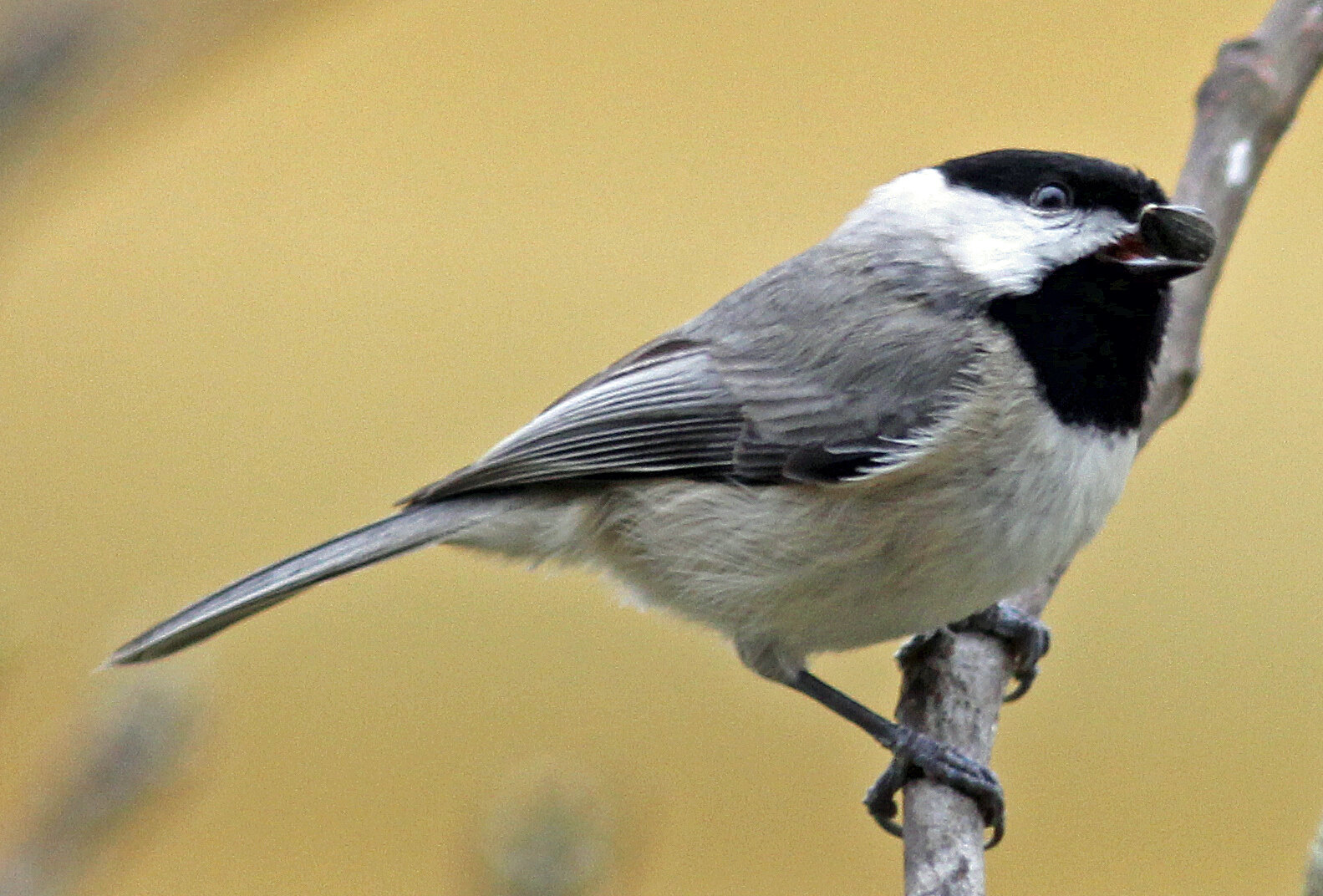
Carolina Chickadees are tiny, noisy and endlessly entertaining birds that often make their presence known long before they are seen. Their name comes directly from the familiar chick-a-dee-dee-dee call that echoes through backyards and woodlots. An older local name for this bird was “Tom Tit.”
That namesake call carries more information than we might imagine. Researchers found that Carolina Chickadees change both the number and kinds of notes when confronting different predators. A larger, less maneuverable Red-tailed Hawk prompted more introductory “chick” notes and fewer “dees,” while a smaller and potentially more dangerous Eastern Screech-Owl produced fewer “chicks” and more “dees.” Other chickadees responded more strongly to the calls associated with the greater threat.
Chickadees are easily recognized by their black cap and bib, gray back, white cheeks and pale underside. They measure less than five inches long and weigh under half an ounce. Two together would still weigh less than the one-ounce limit for an ordinary First-Class letter—although neither bird nor postal carrier would approve of the experiment.

Many people confuse the Carolina Chickadee with the Black-capped Chickadee of more northern climates. The two look remarkably similar, although the Black-capped is slightly larger and their songs differ. Here in Louisiana, the identification is simpler: Carolina Chickadee is the resident species, while Black-capped Chickadee is not included on the state’s official bird list.
Although chickadees readily visit feeders and carry off black oil sunflower seeds, insects and spiders make up most of their diet during the warmer months. A close look at a feeding chickadee reveals that it handles a seed differently from a cardinal or finch. It carries the seed to a perch, wedges it beneath its feet and hammers the hull open with its bill rather than crushing it outright.
Carolina Chickadees are cavity nesters. A pair may excavate soft, decaying wood, use a natural opening or move into an abandoned woodpecker hole. They also readily accept nest boxes. A bluebird-style box can work, but the entrance should be reduced to about 1⅛ inches—large enough for a chickadee while helping exclude House Sparrows and European Starlings.
Inside the cavity, the female builds a nest of moss and bark and lines it with hair or other soft fibers. A clutch may contain three to ten eggs. The female incubates them for about 12 to 15 days, and the young remain in the nest another 16 to 19 days before fledging.
For such a small bird, the Carolina Chickadee has an outsized personality. Its constant movement, conversational calls and fearless visits to our feeders make it one of the most familiar—and most rewarding—resident birds of Iberville Parish.